



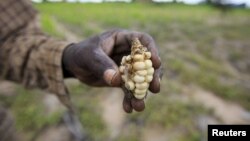
The African Development Bank Group (ADBG) says it will commit $10 billion over the next five years to boost Africa’s efforts to end hunger and become a primary food provider for itself and the rest of the world.
Bank group president, Akinwumi Adesina, announced the funding Wednesday at the Dakar 2 Africa Food Summit in Diamniadio, east of the Senegalese capital of Dakar.
In a statement, Adesina urged more than heads of state, government ministers, private sector, farmers, development parners and corporate executives to work out ways of delivering food to Africans.
The Dakar 2 summit — under the theme Feed Africa: food sovereignty and resilience — is taking place amid supply chain disruptions caused by the Covid-19 pandemic, climate change and Russia’s invasion of Ukraine.
More than a thousand delegates and dignitaries attended, including the President of Ireland Michael D. Higgins.
The Government of Senegal and the African Development Bank Group are co-hosting the summit, eight years after the inaugural Dakar 1 summit where the then newly-elected Adesina announced the Bank’s Feed Africa strategy.
Officially opening the summit, President Sall — who is also the African Union chairperson — said the time had come for the continent to feed itself by adding value and stepping up the use of technology.
Sall said: “From the farm to the plate, we need full food sovereignty, and we must increase land under cultivation and market access to enhance cross-border trade.”
Moussa Faki Mahamat, chairperson of the African Union Commission, said the Dakar summit was timely and would provide innovative solutions to help Africa become less dependent on food imports.
“Food sovereignty should be our new weapon of freedom,” Mahamat told the gathering. He urged development partners to work together within existing structures, such as Agenda 2063 and the African Continental Free Trade Area, for sustainable transformation.
Mahamat commended the African Development Bank for rolling out transformative initiatives, including a $1.5 billion emergency food production facility in 2022 to help African countries avert a potential food crisis following Russia’s war in Ukraine.Kenyan president William Ruto, also said, “It is a shame that 60 years after independence, we are gathered to talk about feeding ourselves. We can and we must do better.
Adesina noted that “today over 283 million Africans go to bed hungry every day. This is not acceptable. No mother should ever have to struggle with rumbling of the stomach of a hungry child.
“We must raise the bar. We must raise our ambition. We must arise and say to ourselves: it is time to feed Africa. The timing is right, and the moment is now. Feed Africa; we must.”
He urged the leaders to turn political will into decisive actions to deliver food security for Africa.
“We must strongly support farmers, especially smallholder farmers, majority of whom are women, and get more young people into agriculture. And we must take agriculture as a business, not a development activity, and boost support to the private sector.”
President Higgins of Ireland said with Africa’s young population accounting for about 20% of the world’s young people, the continent had great potential. He said the rest of the world would look up to it in the future.
“Let us make this century Africa’s Century, one which will see the continent become free from hunger,” Higgins said.
In his message to the summit, United Nations Secretary-General Antonio Guterres acknowledged that Africa was currently facing the challenges of climate change and food insecurity, as the Russia-Ukraine war had caused the price of fertilizers to shoot up and made their supply difficult.
He pledged the UN’s support to help Africa become a global food powerhouse.
President Muhammadu Buhari of Nigeria said countries must offer more robust support for farmers, dedicate a chunk of the national budget to agriculture, and motivate youth and women to farm.
Buhari said: “Feeding Africa is imperative. We must ensure we feed ourselves today, tomorrow, and well into the future.”
He commended Adesina and the African Development Bank for rolling out special agro-industrial processing zones across the continent, including in Nigeria.
He said: “Special agro-industrial processing zones are game changers for the structural development of the agriculture sectors. They will help us generate wealth, develop integrated infrastructure around special agro-processing zones, and add value.”
During the three-day summit, private sector players are expected to commit to national food and agriculture delivery compacts, to drive policies, create structural reforms, and attract private sector investment.
Central bank governors and finance ministers are expected to develop financing arrangements to implement the food and agriculture delivery compacts, in conjunction with agriculture ministers, private sector players, commercial banks, financial institutions, and multilateral partners and organisations